Agentic AI Maturity & Strategy at Google Cloud Summit London 2026

19th Jun 26 . Dominic Bryce . SEO

If you still think spending 10 minutes prompting AI to create your seasonal email campaign, and another 10 minutes rehashing the response means your hotel team is fully utilising AI, the ground has shifted beneath your feet.
That’s what I took away after attending the June 2026 Google Cloud Summit in London. It felt like the perfect time to explore how the largest organisations are implementing agentic AI, especially given that within the hospitality and leisure industry, 3 out of 10 businesses are not using AI - an area where we specialise as a digital marketing and web development agency.
During the introduction to the keynote, the speaker noted that the word "agentic" had been used a grand total of once last year, which gives you an idea of how much things have changed in a mere 12-month span.
Before going further, I should caveat that I do not work in IT or infrastructure. This piece is written for hospitality GMs, hotel marketing managers, or those interested in getting a high-level view of what is happening in the agentic AI space at large AI-first tech organisations.
Agentic AI and automation are starting to gain large-scale traction, but let's have a look at what some of those leading the way in large organisations were talking about at the Google Cloud Summit.
Agentic AI automation has become accessible to almost any business. However, every company is at a different stage in their maturity.
But when you’re looking to build on this and accelerate, it’s important to take a look at what capabilities your business has; what skills people have, and what systems you have in place that you’ll need to use.
Many leaders at the event said that experimentation and bravery are still key within AI right now. But, when your business is reaching the end of its experimentation phase, it’s time to map out your agentic AI system, to ensure:
You need to feed AI your organisational knowledge and data - this is the brain for the AI agent.
Treat your AI and agents like you’re onboarding a new employee, it needs some time invested into learning and training. Give AI connections, feeds of quality data, and context to be useful. It doesn’t just need to know what your B&B rate is next month; it needs to know that your PDR space has a maximum capacity of 20, and that your brand doesn’t use the word ‘cheap’.
During the Google Cloud Summit talks, speakers from Deloitte, ITV and Ocado talked about giving AI the context it needs, and further than just data, it needs the 'tribal knowledge' stored within your company's teams.
We know that context is hugely important, with consumer AI LLMs introducing improved AI context and memory too. Google itself introduced Personal Intelligence earlier in the year, pulling data from users’ Gmail and Google Photos to give Gemini a whole range of context and information about you to improve AI responses. Perplexity’s new Brain increased its correctness by 25% and cut the cost of tasks that require historical context by 13%.
Within SEO and GEO, we can provide AI agents context and more efficient ways to access our content in a wide range of ways, including some of the emerging files to help AI bots understand and accurately reference our business and website, such as llms.txt, entity.json, brand.txt, faqs-ai.txt, new ways to make websites accessible to AI agents, as well as allow agents to make ecommerce purchases, agentic table booking functionality, create agentic accessible forms (useful for B2B lead gen such as M&E in a hotel context), new ways to measure agentic visits or conversions, and so much more when it comes to wider agentic web development.
We, in fact, have always educated bots about our brand and its wider context by creating websites and pages, enriched with all of the facts and details about our brands. These are all details that a human or AI needs to answer the increasingly wide variety of prompts and conversations that are now happening alongside traditional search.
The main difference now is that AI agents prefer cold, hard facts and stats, structured data and tables, and simple, direct, descriptive language, which marks a real shift compared to how information was presented to exclusively human audiences.
Many leaders see the benefits of AI as a route to improved profitability. But equally, businesses are also seeing their annual AI token budgets disappear in just months, with AI costs soaring for businesses.
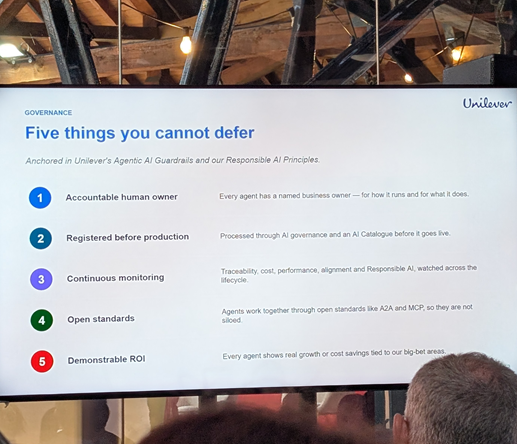
In a talk at the Summit, Unilever spoke about governance, AI Guardrails and their ‘Responsible AI Principles’. Being able to measure the cost of an AI agent that is planned to be built, and crucially, every agent needs to demonstrate an ROI - growth or a cost saving in key areas of the business.
The theme throughout the talks was definitely building in governance, guardrails and security before the business gets to work creating agentic workflows for every use case they can think of. Running agents can be expensive, so before adding costs, it’s important to understand whether the agent is going to bring real commercial value or not first.
For large enterprises, the main issue isn't the AI models themselves, but the fragmentation of data. The data is what underpins everything for Google’s new Gemini Enterprise, so when information is in a variety of legacy platforms, autonomous agents are very hard to implement.
In a hospitality context, AI agents are more difficult to deploy if your PMS, booking engine, and analytics are operating in silos. Consolidating this data is the first step before deploying agents to improve the guest journey.
But, as we heard at the event, the biggest tech-forward brands are consolidating and improving their data foundations.
There are a myriad of agentic AI companies out there that can automate and improve their own niche areas, but there was a real emphasis on consolidating everything so that everything can connect. Instead of treating AI as a collection of isolated, shiny tools, Unilever argued for an ecosystem approach that is centralised and governed.
There was an emphasis throughout on fixing processes and people (not just your data), before you try to automate those processes with agents: which AI model to use is much less important than the processes and systems put in place to manage your AI rollout.
Identifying use cases, for some organisations like Unilever it was a case of creating agents to fulfil a process when it provides a positive ROI, for other organisations like HSBC it was using agents to upgrade the experience and services they provide to customers.
RightMove talked at the Summit about how the best way for leaders to learn, understand, and drive AI in their own organisations is to get stuck in and try it out themselves. Leading by example, getting on board with as well as new platforms and processes yourself; role modelling or walking the walk is one of McKinsey’s four building blocks of change management, so to help get your teams on board, this is your first port of call.
Communication is essential because of the potential sentiment there is around AI. A speaker from Ocado talked about introducing their agentic customer chatbot and how communication kept the team on board with the rollout. Their chatbot was able to resolve a much greater percentage of customer issues successfully within the chat itself after their rollout, with the outcome being that actual staff were able to spend more time on resolving the more complex cases that AI can’t solve.
This also shows that AI can’t just sit in the IT department; the AI roadmap needs to be communicated effectively top-down, because it touches on most areas of the business, and the processes and systems need to develop trust in the system's outputs, with communication and measurement being a large part of that.
The overall theme of the day was that leaders looking to scale the business and teams beyond the initial experimentation stage need to prioritise building a centralised, well-governed foundation, with a scalable context layer and data platforms that the entire business can build upon.
The most popular session of the whole day was ‘AI Masterclass: Vibe Coding for Non-Coders’ - the queue for this one went through the entire venue. It’s clear that vibe coding is a trending topic, with non-technical users from across organisations interested in understanding how to prototype or experiment with building their own.
Unsurprisingly, I didn’t manage to make it to this one. I didn’t feel too left out, though - I have been using Google Antigravity, their vibe coding tool, which manages agents to plan, create and test software, just using natural language prompts.
This has allowed me to build my own SEO tools for my own work, and in rolling this out across our own business, we will be able to spend far more time on taking action on tasks that will make a real difference for our hotel client’s digital marketing performance, by spending less time on admin tasks like exporting and formatting data, doing in-depth research or turning meeting notes into summaries and actions.
Using these tools to build shows you on a small scale why strict guardrails, governance and security are a major thing to tackle now more than ever. It is possible for development and wider teams to push new web changes and features live at a much greater speed, so internal processes need to be updated not just for agentic AI, but the increasing pace of change and throughput throughout entire organisations.
Vibe coding can also help show non-coders how AI agents operate on a small scale, and what needs to be in place for them to be effective. Using Antigravity has helped me to understand the importance of guardrails, such as introducing rules in the form of MD (markdown) files for your agent saves massive potential issues and a lot of refinements and bugs down the line.
As an SEO specialist, I am familiar with crawl budget optimisation, but with vibe coding it’s about token efficiency, I was familiar with context windows for Generative Engine Optimisation (GEO) but with vibe coding you context drift when AI begins to forget something you told it in the past as its memory fades.
Now is a fantastic time to try out vibe coding as a non-coder, because Google’s showcase of Gemini Enterprise, and it is showing a clear trajectory for almost anyone in an organisation (not just technical teams) may in the near future augmenting everything they do each day with the help of AI agents.
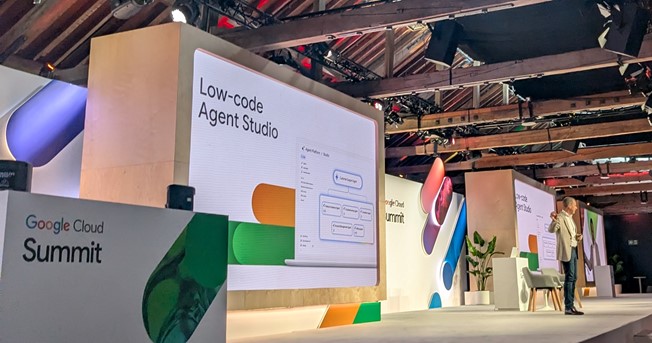
The reality from the summit is clear: agentic AI is not a futuristic concept; it’s already happening for the most forward-thinking businesses.
For hotel leaders, my advice isn’t to rush out and subscribe to every new AI tool you can find, but instead review your siloed systems, auditing your data foundations and establishing clear governance.
The tools to drive efficiency in key business areas are out there; some of your teams are already using different AI platforms in different ways for efficiencies, and could give you a myriad of potential use cases for efficiencies. But the question is whether your hotel's infrastructure and teams are capable of supporting the rollout of a unified AI roadmap as a standardised operating model across the business.
Take your digital marketing skills to the next level with The Click Academy. Designed for marketers and business owners, our courses combine practical marketing expertise with specialist hospitality knowledge.
The Advanced Digital Marketing for Hoteliers course gives you the tools and confidence to understand performance, make informed decisions and drive better results. Delivered by our Agency Specialists, it covers proven strategies to help increase direct bookings, maximise ROI and compete more effectively with OTAs.