Do OTAs Influence AI SEO & LLM Hotel Bookings?

22nd Apr 26 . Dominic Bryce . SEO
AI is rapidly reshaping how travellers discover and book hotels - but it’s not starting from scratch. Behind the scenes, platforms like ChatGPT, Gemini, and Google AI Mode are heavily influenced by the same players that have long dominated traditional search: online travel agencies (OTAs).
So what does this mean for hotels trying to grow direct bookings? Are OTAs strengthening their grip in the age of AI, or is there a new opportunity to bypass them altogether? In this blog, we explore how AI uses OTA data, the difference between citations and true brand visibility, and what hotels need to do to stay competitive as booking journeys evolve.
Our hotel marketing strategies have always focused on reducing reliance on expensive online travel agencies (OTAs) and increasing direct bookings.
From conversion-focused websites to paid campaigns and SEO, the goal is simple: drive lower-cost bookings and minimise OTA commission.
But the landscape is shifting. AI platforms like ChatGPT, Gemini, Google AI Overviews and Google AI Mode are changing how travellers search, compare and book hotels.
This raises some important questions:
Research shows that OTAs now account for 63% of bookings for independent hotels, while larger hotel groups maintain a higher share of direct bookings (Cloudbeds, 2026).
Data from SiteMinder echoed this increasing reliance, showing that 26% of travellers now start hotel research on Booking.com and other OTA websites, beating Google for the first time as the primary starting point for the journey (SiteMinder, 2026).
This means that hotels are paying out huge sums of money to OTAs, and that hotels have a lot to gain from growing their own direct booking channels, to reduce this reliance and expense.
In 2009, a Cornell University study showed that listing on the Expedia OTA increased hotel direct website bookings by 9% to 26% (Anderson, 2009).
The follow-up study in 2011 data showed that for every single room booked through an OTA, the hotel received between three and nine extra direct bookings on their own website, entirely due to discovering the hotels via OTAs (Anderson, 2011).
Even today in 2026, 18% of guests who began with an OTA search ended up booking directly through a hotel website, which is an increase from last year (Siteminder, 2026).
But is AI going to increase this dependency, or will AI help guests bypass OTAs and come directly to your hotel?
First off, let's recap at a high level on some of the pros and cons of OTA bookings versus direct bookings:
OTAs utilise their large marketing budgets and powerful websites to achieve greater visibility in traditional search than most direct hotel websites. They leverage this dominance across ads and SEO to drive more searchers to book through their platforms, making hotels increasingly reliant on them and generating revenue through commissions.
Before we compare the performance of OTAs and hotels in AI search, it’s important to understand the difference between an AI citation and an AI brand mention, because one is barely noticed by users, while the other is what actually drives direct bookings:
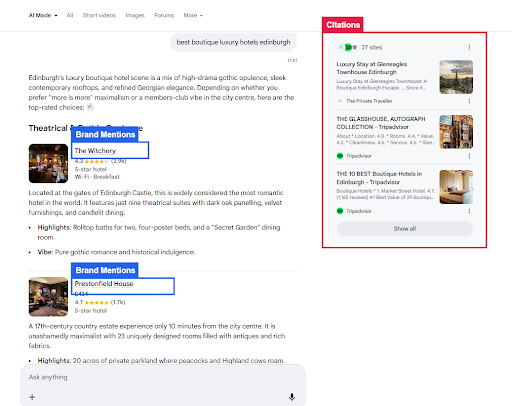
AI Brand Mentions vs AI Citations for Hotels in Google AI Mode
An AI Brand Mention is the actual appearance of your hotel within the AI's generated response.
This is when the AI explicitly names your property, highlights your unique selling points, and presents you as the definitive answer to the user's prompt.
It is the narrative text or visual card that tells the user what to book, rather than just where the data came from. When it comes to driving direct revenue, AI brand mentions are significantly more valuable to a hotel.
Citations show you where AI sourced its information. Citations are dominated by OTAs (like Booking.com) and aggregators (like TripAdvisor) because they provide the massive, structured data sets and reviews that Large Language Models require to form a consensus.
The problem here is that a citation is not your hotel getting recommended to a user; an AI citation 61.7% of the time does not result in brand mention (Growth Memo, 2026).
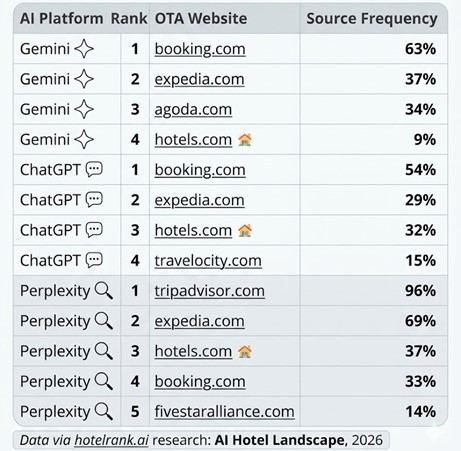
Studies show that OTAs dominate AI citations, with OTAs making up over 50% of AI citations (hotelrank.ai). The most influential OTAs for AI citations vary depending on the AI platform.
Below is a breakdown of the top OTAs by platform:
Although citations do not provide the full picture of how an AI answer is generated - since the training data used by LLMs is a black box - they are only part of the process.
Citations are used to support the AI’s response, but the sources you see are not necessarily the ones that determined which hotel is recommended.
For example, we know that Reddit and YouTube are used extensively as sources by ChatGPT when it is creating a response, but only 50% of ChatGPT sources get linked in citations (Ahrefs, 2026).
So we can say with confidence that OTAs, with their millions of structured pages, aggregated reviews, and comprehensive hotel data points, are easier for AI platforms to use to understand hotels at scale, and carry a lot of weight in an AI’s training data, when it comes to determining which hotel to recommend in response to a user prompt.
To explain why this is an opportunity, it is helpful to understand whether the largest AI platforms are built to send their users to a hotel website.
Despite all of the news around ChatGPT replacing search, Google has become the largest platform for AI-assisted searches, thanks to around a third of searches triggering their AI Overview at the top of search results, as well as Google Gemini and Google AI Mode (SparkToro, 2026).
ChatGPT is highly reliant on search, and activates its search feature on 34.5% of prompts, and is primarily used for generation and work, so only around a third of ChatGPT prompts are search-like, seeking out something like a hotel.
ChatGPT itself has a 96% lower click-through rate to websites than Google does (Ahrefs, 2026). Google and YouTube themselves are the websites that receive the greatest number of visits from ChatGPT, suggesting that a more typical booking journey starting in ChatGPT might end up heading to Google to find your hotel’s website (Semrush, 2026).
Google is the largest hotel review platform, receiving more reviews globally than TripAdvisor. It has access to extensive hotel data through its Google Business platform, which powers Maps, Google Hotel Metasearch, and Google AI Mode - its new search experience that combines AI chat with traditional search and is being increasingly integrated into the search journey.
If you have a Google Business profile that links to your hotel website, and a metasearch connection set up feeding your availability and rates to Google, you will be driving direct bookings from Google AI Mode.
The best thing about this for hotels? 79% of Google AI Mode clicks go to hotel Google Business Profiles, and 16.3% go directly to hotel websites (hotelrank.ai, 2026).
This means brands have a chance to beat OTAs with their direct rates and direct website.
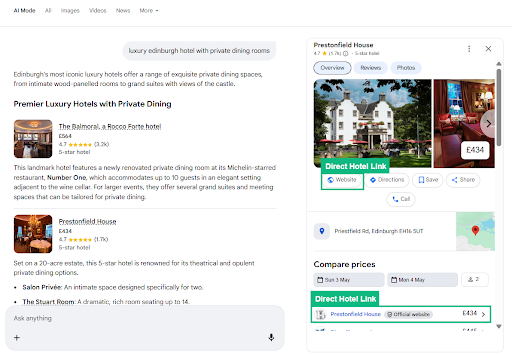
Direct hotel website links in Google AI Mode from your Google Business Profile and from your metasearch ARI feed.
This may change in the future, however, as Google introduces ads into AI Mode. It is also likely that sponsored metasearch links will be included, allowing OTAs to capture more of these bookings - much like they already do in traditional Google Hotel Search.
Overall, OTAs are one way to increase your visibility within AI platforms, thanks to their comprehensive hotel listings, structured data, and extensive review content.
In addition, their loyal audiences often begin their research on OTA websites or apps. Combined with significant advertising spend and strong international reach, OTAs can also help increase awareness of your hotel and drive direct bookings, thanks to the ‘Billboard Effect’.
But here’s the most important point: while OTAs are a useful tactic in your AI visibility toolkit, there are still many ways to increase direct bookings and improve your own website and brand visibility in AI recommendations.
Overall, your website and other owned and controlled sources (such as social media and listings) are primary inputs used by AI models to understand and describe your hotel.
If you invest in improving your AI visibility and clearly communicate the value of booking direct, you can future-proof your margins while strengthening the value of your website and brand.
Get in touch today if you’re interested in growing your AI visibility and increasing direct bookings.
Do OTAs increase direct bookings?
Yes, indirectly. While their primary goal is to keep the commissionable booking, OTAs drive "spillover" traffic to your website. Many guests use OTAs as a directory to find hotels, but will visit your official site to look for better photos, more detailed info, or a "book direct" incentive before making their final decision.
Do OTAs help my hotel get found in AI platforms?
Yes - OTAs are very useful data sources used by AI platforms to understand a hotel's amenities, review sentiment and features. AI uses OTAs as a hotel information source more than 50% of the time (hotelrank.ai, 2026).
What is the billboard effect for hotels?
The Billboard Effect is when a hotel receives more direct bookings by appearing on an online travel agent (OTA) such as booking.com. The OTA acts as a billboard advert, allowing the hotel to be seen by a wider audience, increasing brand awareness, and increasing the number of guests seeking out your website to book direct.
What are the top UK OTAs?
Based on February 2026 SEMRush data, the dominant players in the UK market are:
What is going to happen next in AI hotel bookings?
The next big change for AI hotel bookings is agentic; bookings being assisted, or even fully automated, directly within Google search.
While ChatGPT has abandoned plans to move forward with agentic hotel bookings, Google is steaming ahead with Project Mariner, as well as agentic ecommerce with Universal Commerce Protocol (UCP), with Google agentic restaurant reservations and more already happening.
Google are even launching WebMCP for making every website usable by AI agents, and Google Agent for measuring agentic visits.
Take your digital marketing skills to the next level with The Click Academy. Designed for marketers and business owners, our courses combine practical marketing expertise with specialist hospitality knowledge.
The Advanced Digital Marketing for Hoteliers course gives you the tools and confidence to understand performance, make informed decisions and drive better results. Delivered by our Agency Specialists, it covers proven strategies to help increase direct bookings, maximise ROI and compete more effectively with OTAs.